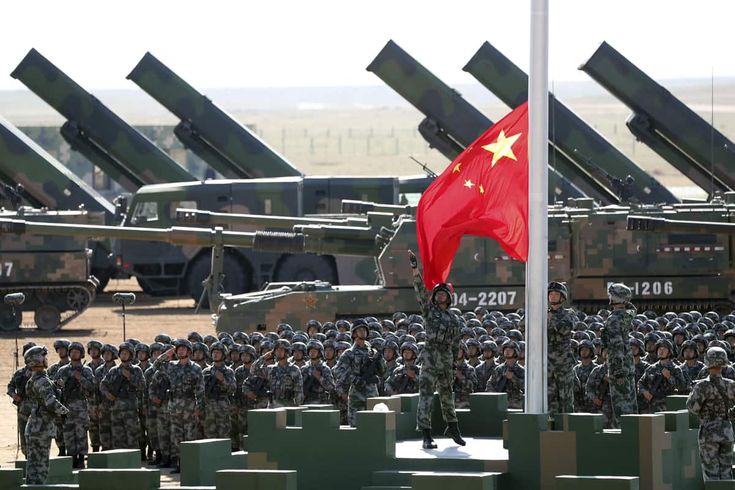
china holding drills .
Invading Taiwan Is Still Too Risky
China officially ended its live-fire military exercises around Taiwan this week, but its Taiwan Affairs Office has issued a white paper emphasizing “peaceful reunification” with the self-ruled island—while reserving the right to use force. It looks like dramatic escalation in response to U.S. House Speaker Nancy Pelosi’s visit to Taiwan can be ruled out, even as aggressive Chinese intrusions across the median line in the Taiwan Strait become the new normal.
In the aftermath of Pelosi’s visit, it’s worth considering just why China doesn’t invade Taiwan, despite near-constant threats to do so. There are a few factors that keep things from kicking off in the Taiwan Strait.
First, there is China’s hope that Taiwan will return to the mainland without war. Polls in Taiwan make that seem like a fantasy: Just 2 percent of Taiwanese identify solely as Chinese, a figure that has fallen from 25 percent a decade ago, thanks to generational change and Beijing’s aggression and crackdowns on human rights. Most of the Taiwanese public holds negative views of the Chinese Communist Party (CCP), and Beijing’s destruction of legal freedoms in Hong Kong turned the “one-country, two systems” principle into a joke.
But it’s possible that Chinese leaders have convinced themselves Taiwan’s return might happen: The white paper paints the Taiwanese public as deceived by the ruling Democratic Progressive Party and the West, and China’s ambassador to Australia has said the polls are misleading. Chinese officials lie about their own system so regularly, they assume that others do the same. Furthermore, the Taiwan Affairs Office also can’t be honest even internally about its own failure to woo Taiwanese to the idea of reunification, because it would expose itself.
Perhaps more likely: The CCP leadership thinks it may be able to force Taiwan to surrender through coercion and subversion rather than outright war. The CCP has spent a lot of time and money building ties with groups in Taiwan, from the once-ruling Kuomintang to organized crime. As I argued last week, Chinese leaders also hold out for the possibility of U.S. collapse, leaving Taiwan without its main protector.
Even if Beijing rules out peaceful reunification, the risks that would accompany an invasion are very high. There is no guarantee of Chinese success if it invades Taiwan, even without direct U.S. intervention. China hasn’t fought an actual war for 43 years, since its failed invasion of Vietnam in 1979; although it has invested heavily in its military, it has had no opportunity to test its doctrine or technologies.
Despite Chinese claims that an invasion would be quick and easy, it would be an amphibious attack of an unprecedented scale against a Taiwanese opponent that has prepared for the scenario for decades—even if it faces its own morale and logistical problems.
Then there are the geopolitical risks of an invasion, most importantly the possibility of full-scale war with the United States. On the one hand, a faction within Chinese military academia genuinely believes invading Taiwan could demonstrate superior will and push the United States out of the Asia-Pacific region. There are certainly questions about how willing Washington would be to go to war and if it could defend Taiwan.
On the other, no one in Beijing wants to suffer a humiliating defeat at the hands of the world’s most powerful military—or for the world to end in nuclear flames.
Putting the United States aside, an invasion of Taiwan would destroy China’s claims that it is a peaceful power—and with them Beijing’s relations with Tokyo, which has strong ties to Taipei. At least at first, a conquered Taiwan could not be sealed off from the world like Tibet or Xinjiang, where atrocities can remain somewhat hidden. Even if China cut off Taiwan’s internet, the island is high-tech enough to get out images of war or occupation that would damage China’s reputation.
Relatedly, an invasion could be followed by an economic recession at home. Southern China’s economy is entangled with Taiwanese suppliers and capital, which would be ruined by a war. Technology firms such as Taiwan Semiconductor Manufacturing Co. have scorched-earth plans in place for their factories in the event of an invasion, and talent would flee wherever possible. The West’s financial muscle exerted over Russia’s war in Ukraine has also caused concern in Beijing, even though extensive sanctions on China would cause much more damage to the global economy.
Finally—and perhaps most potent—is the political risk of invading Taiwan.
