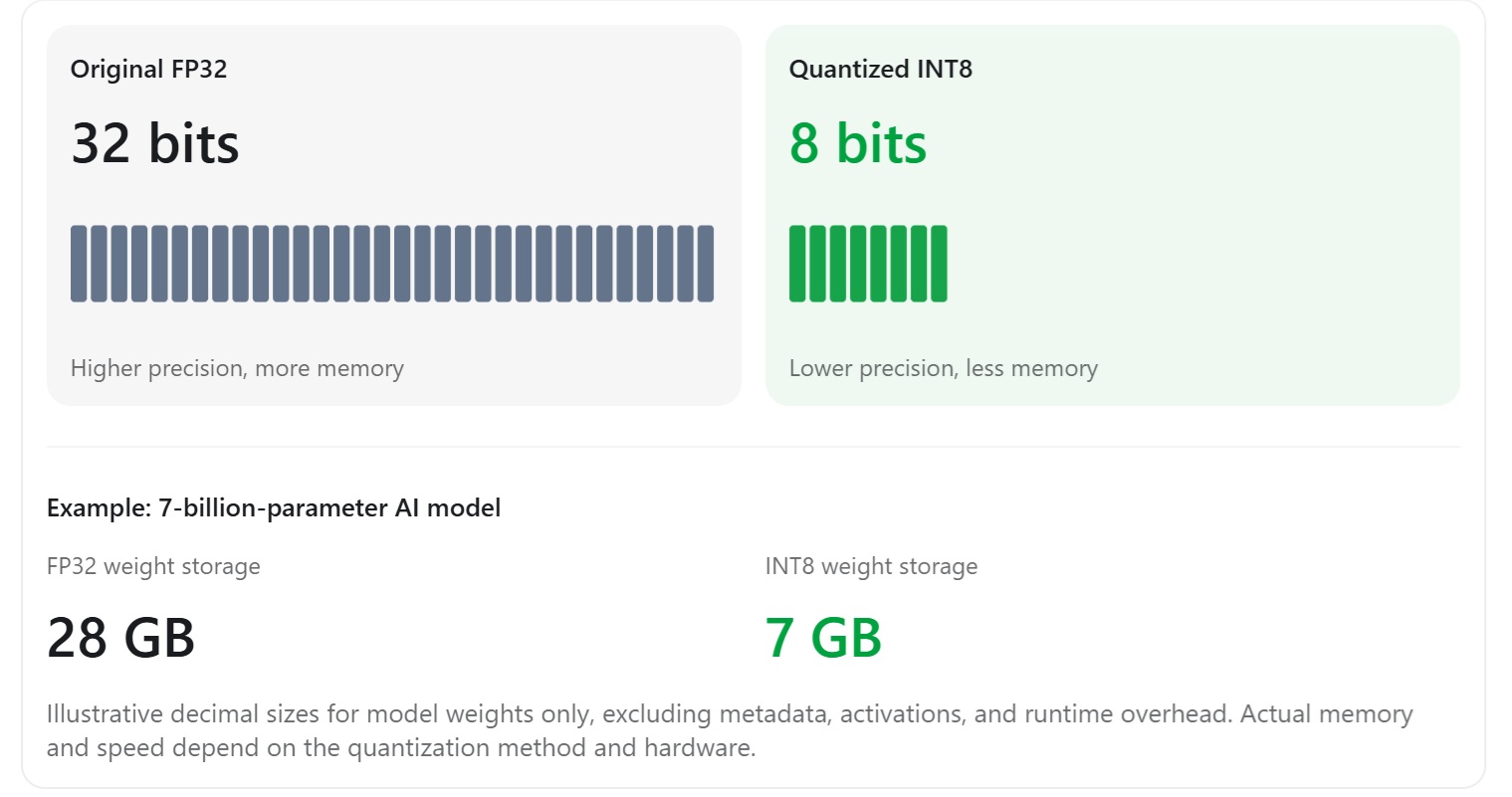
Quantization is a technique that reduces the memory and computing resources needed to run an AI model by representing its numerical parameters with fewer bits.
For example, instead of storing model weights using 32-bit floating-point numbers (FP32), we can approximate them using 8-bit integers (INT8).
This can make AI models more practical to run on laptops, edge devices, and local servers.
How quantization works
Apply it today: Run AI locally
Suppose you want to experiment with an AI model on your laptop or a local engineering lab server.
A full-precision model might require too much memory. A quantized version of the same model could fit on your available hardware without requiring a cloud inference service.
Your 5-minute exercise
I want to run a 7-billion-parameter AI language model locally. Compare FP32, FP16, INT8, and 4-bit quantization in terms of approximate model-weight memory, inference speed, accuracy trade-offs, and hardware requirements. Recommend which format to evaluate first on a computer with 16 GB RAM. Clearly identify assumptions.
Compare the estimated memory requirements and identify a configuration that could fit your machine. Remember that smaller models are not automatically faster on every processor, and aggressive quantization can reduce answer quality.
Today’s takeaway: Quantization makes AI deployment more resource-efficient by reducing numerical precision. It is especially valuable when running AI locally, where memory, power, and hardware costs matter.
