Day: November 12, 2026

Yocto Training: Essential Build Packages

build-essential is a metapackage on Debian and Ubuntu that installs the basic tools for compiling software. It typically pulls in:

  • gcc and g++ — C and C++ compilers
  • make — runs build instructions
  • libc6-dev — C library headers and development files
  • dpkg-dev — tools for building Debian packages

chrpath is a small Linux utility for inspecting and changing the RPATH/RUNPATH stored in an ELF executable or shared library. These paths tell the dynamic linker where to look for required shared libraries.

It’s commonly used during packaging to remove or adjust build-time library paths before distributing a program. Use it carefully: changing the path incorrectly can prevent the program from finding its libraries.

chrpath -l ./program # show its RPATH/RUNPATH
chrpath -d ./program # remove it
chrpath -r ‘$ORIGIN/lib’ ./program # set a relative path

cpio is both a command-line utility and a package that provides it. It creates and extracts archive files, often used for backups, packaging, and moving files while preserving metadata.

You may see it in Linux system workflows—for example, in initramfs images used during boot, or in software package archives. It’s similar in purpose to tar, though the archive formats differ.

Create an archive from files under mydir

find mydir -print | cpio -o -v -H newc > mydir.cpio

Extract it into the current directory

cpio -i -v < mydir.cpio

-o creates an archive, -i extracts one, -v lists files as they’re processed, and -H newc selects the commonly used newc archive format.
Practical AI: Quantization

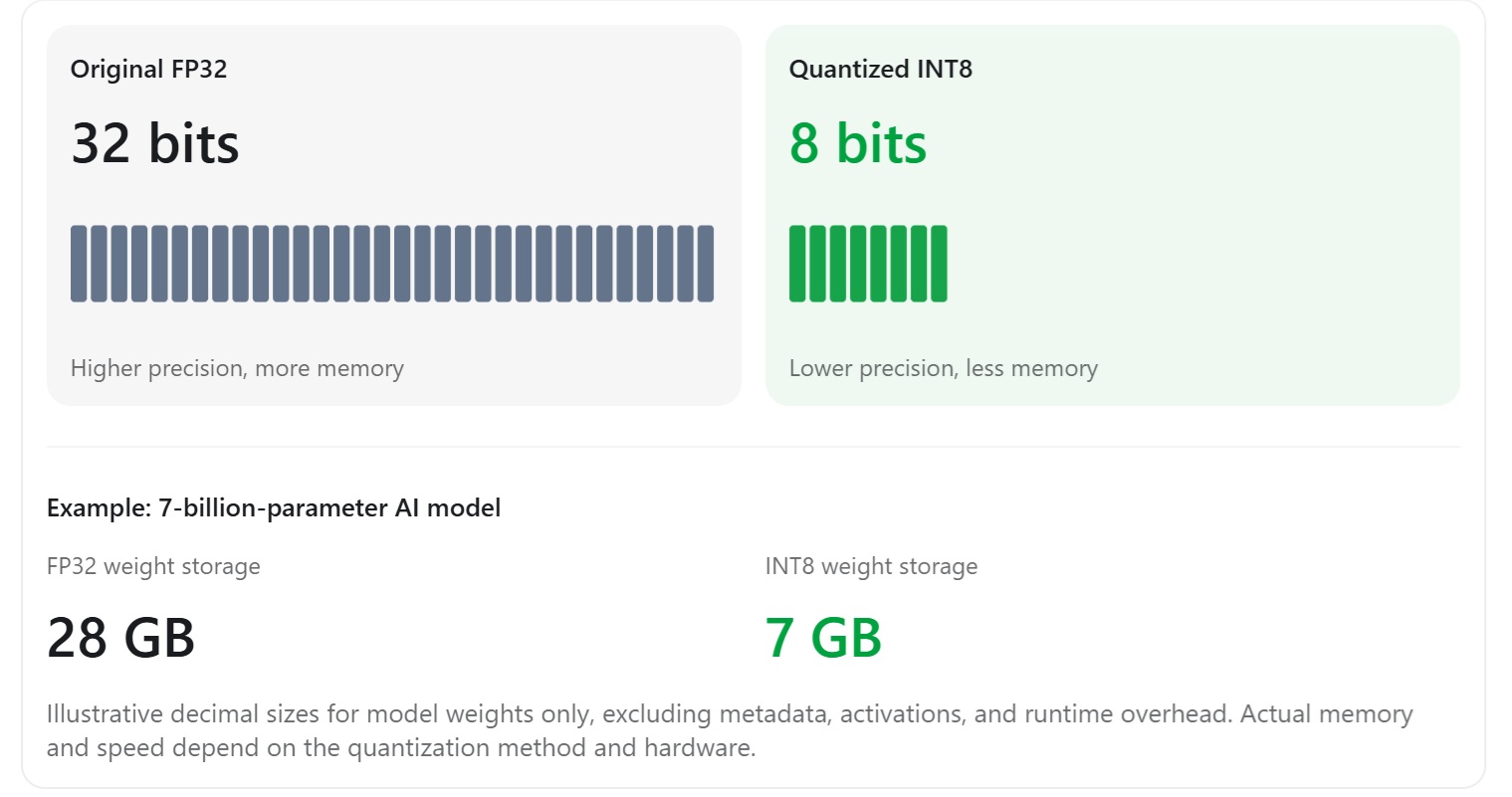
Quantization is a technique that reduces the memory and computing resources needed to run an AI model by representing its numerical parameters with fewer bits.

For example, instead of storing model weights using 32-bit floating-point numbers (FP32), we can approximate them using 8-bit integers (INT8).

This can make AI models more practical to run on laptops, edge devices, and local servers.

How quantization works

Apply it today: Run AI locally

Suppose you want to experiment with an AI model on your laptop or a local engineering lab server.

A full-precision model might require too much memory. A quantized version of the same model could fit on your available hardware without requiring a cloud inference service.

Your 5-minute exercise

I want to run a 7-billion-parameter AI language model locally. Compare FP32, FP16, INT8, and 4-bit quantization in terms of approximate model-weight memory, inference speed, accuracy trade-offs, and hardware requirements. Recommend which format to evaluate first on a computer with 16 GB RAM. Clearly identify assumptions.

Compare the estimated memory requirements and identify a configuration that could fit your machine. Remember that smaller models are not automatically faster on every processor, and aggressive quantization can reduce answer quality.

Today’s takeaway: Quantization makes AI deployment more resource-efficient by reducing numerical precision. It is especially valuable when running AI locally, where memory, power, and hardware costs matter.